Charleston County · Private docks
Dock building on the Lowcountry creeks, starting with the permit
A private dock in Charleston County is a permitting project with a construction phase attached, not the other way round. What the state allows across your marsh decides the walkway, the pierhead, the lift and the float — long before anyone drives a pile.
What actually happens when you build a dock here
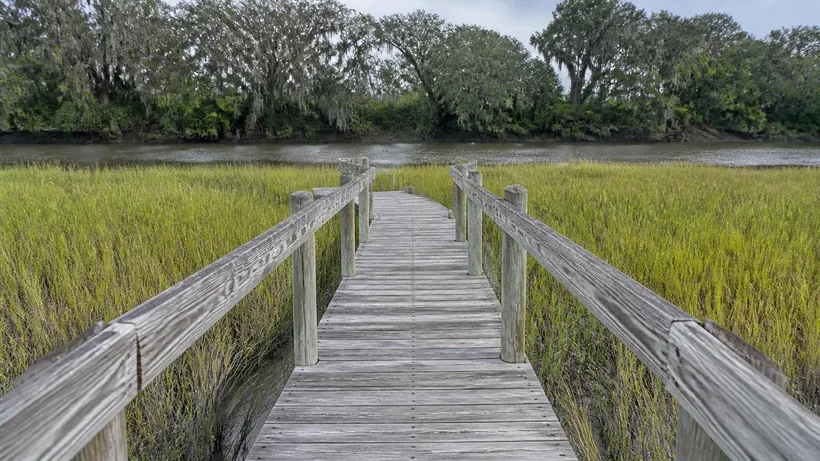
Most people arrive at this with a picture in their head: a walkway out over the marsh, a covered pierhead, a boat on a lift, and a floating dock at the end for the kayaks. It is a reasonable picture and a lot of Lowcountry docks look roughly like that. What surprises owners is the order the work happens in, and how much of the final shape is decided by people who will never set foot on the property.
Building over tidal water in South Carolina is not the same as building on your own high ground. The marsh in front of your lot is a public trust resource. Past the critical line — the surveyed landward edge of that marsh — you are no longer simply exercising a property right. You are asking the state for permission to occupy tidelands, and that permission comes with conditions about size, position, materials and use.
That is why the first useful conversation about a dock is not about decking or lift capacity. It is about three documents: your plat, the position of the critical line on it, and whatever the subdivision or the previous owner already agreed to. Those three things will tell you more about what your dock can be than any catalog will.
The sequence, honestly
- Establish whether the lot qualifies at all. Marsh frontage width, distance to neighboring structures, water depth at the end of the run, protected bottom, and any restriction already recorded against the property. Some lots do not qualify, and it is far cheaper to learn that here than after a design has been drawn.
- Survey and critical line. The position of that line is a survey question with a specific answer. It determines how much of the structure sits over tidelands and how long the walkway has to be.
- Design to the rules, not to the wish list. Pierhead dimensions, walkway width, whether a covered structure is possible, whether a lift is allowed, where the float may sit. The permitting framework constrains all of it.
- Application and review. The joint process brings the state coastal office and the federal side into the same package. This is the part measured in months.
- Construction. Pile driving, framing, decking, ramp and float, hardware, and the lift if there is one. Comfortably the shortest phase for most projects.
Owners who understand that sequence tend to have a much better experience, because the long wait arrives when they expect it rather than as a surprise in the middle of what they thought was a building project.
What we do
Dock Construction
New private docks built for the creek you actually have.
Dock Permitting
The OCRM critical line, the joint application, and what decides your footprint.
Boat Lifts
Lift selection sized to the boat, the tide range and the pierhead.
Floating Docks
Floaters and ramps that stay usable through a six-foot tide swing.
Pierheads & Walkways
The walkway across the marsh and the pierhead at the end of it.
Dock Repair & Rebuilds
Decking, stringers, piles and hardware on an existing structure.
The tide is the design constraint nobody mentions
Charleston runs a tide range large enough that it dictates dock design rather than merely influencing it. A structure that works beautifully at high water can be unusable at low water, and the difference arrives twice a day, every day, for the life of the dock.
This is why the standard Lowcountry arrangement is a hybrid. A fixed walkway crosses the marsh at a height that clears the spartina and the spring tides. A fixed pierhead sits at the end of it. From that pierhead an aluminum gangway runs down to a floating dock, and the float rises and falls with the water so that there is always a surface at boat level. Take the floater away and you have a structure that is comfortable for a few hours either side of high tide and awkward the rest of the time.
The second thing the tide decides is whether your creek is a deep-water site or a tidal creek that goes soft at the bottom of the cycle. Both can be excellent. They are not the same product. On a creek that drains, a floating dock will spend part of each day resting on mud, which is normal and survivable if the float is specified for it and a real problem if it is not. On a deep-water site with current, the questions shift toward pile depth, scour, and how much load the structure takes when the water is moving hard on a spring ebb.
Neither answer comes from a brochure. It comes from someone standing on the site at the right stage of the tide with a rod, looking at where the water actually is.
Marsh crossings are the other cost driver
The distance from usable high ground to usable water is the single number that moves a dock budget most. Two houses on the same street can face very different projects because one has forty feet of marsh in front of it and the other has two hundred. Every additional foot of walkway is framing, decking, piles, fastenings and labor, and on a long crossing the access question changes too — at some point the work stops being reachable from the bank and starts requiring a barge, which changes the schedule as well as the method.
This is also why quoting a dock over the phone is not a serious exercise. The honest version is a look at the survey, a walk of the site, and a figure from the contractor once both of those have happened.
Request a callback
Send the address and what you are trying to build. We will call you back.
Talk through your site
Start with the survey and the critical line. Everything else follows from those two things.
Materials, and what the salt does to them
A dock in a salt creek lives in one of the harder environments a timber structure can occupy: wet and dry twice a day, salt in the air permanently, marine borers below the waterline, and sun on the deck surface all summer. Material choices here are not cosmetic preferences. They are decisions about how often someone will be back out on the structure with tools.
Piles
Pressure-treated timber piles are the common structural answer, driven rather than augered where conditions allow, because a driven pile develops far better capacity in this ground. The detail that matters most over time is damage. An undamaged treated pile does well; a pile with a gouge through the treated envelope is an entry point for borers, and that damage happens below the waterline where nobody looks.
Framing and decking
Treated framing is standard. On the deck surface there is a real choice between treated timber, composite, and hardwood, and the trade-offs are honest ones: composite avoids splinters and annual finishing but gets hot under a Lowcountry sun and costs more up front; timber is cheaper and cooler underfoot but wants attention; hardwood sits between them on both counts.
Hardware is the part that fails first
This is the single most useful maintenance point anyone can give a new dock owner. In a salt environment the fastenings, brackets, hinges and bolts almost always degrade before the timber does, and mixing metals accelerates it through galvanic action. Hot-dip galvanized and stainless have different strengths and different failure modes, and the wrong pairing in contact with treated timber will corrode faster than either would alone. An annual look at the hardware is what keeps a hardware problem from becoming a structural one.
Where we work
The radius here is set by water rather than by drive time. These are the creeks, sounds and reaches around Charleston where the work happens, and each one has its own character — depth, current, marsh width, and in some cases its own local constraints.
Mount Pleasant
Shem Creek to the Wando, and everything off Rifle Range Road.
Sullivan's Island
Cove Inlet and the back-island creeks.
Isle of Palms
The Intracoastal side, Hamlin Sound and the marina reach.
Daniel Island
Beresford Creek, Ralston Creek and the Wando frontage.
James Island
Ellis Creek, Clark Sound and the Stono side.
Johns Island
Bohicket, Church Creek and the deep Stono bends.
Shem Creek
A working creek with rules of its own.
Awendaw
Bulls Bay, Sewee and the long marsh crossings.
Repairs, and knowing which one you have
Not every problem on an older dock is a rebuild, and not every rebuild announces itself. Three broad situations come up repeatedly.
Surface and hardware. Cupped or soft decking, lifted fastenings, a ramp hinge that has seized, float attachment points working loose. This is maintenance. It is worth doing on schedule precisely because deferring it transfers load into the frame.
Framing. Stringers softening where they meet piles, joist hangers failing, a pierhead that has developed a noticeable bounce. Still repairable, usually in sections, and the moment to look properly at everything else while access is open.
Piles. The structural case. A pile that has lost section below the waterline, or has moved, changes the whole conversation, because everything above it depends on it. This is also where permitting can re-enter the picture: substantial reconstruction of a dock is not always treated the same way as repairing one, and assuming otherwise is a mistake worth avoiding.
An older structure that has been maintained is usually worth keeping. One that has been left alone for a decade may be cheaper to rebuild than to chase, and the only way to know which is to have someone look at the piles rather than the decking.
Questions people ask before they build
Do I need a permit to build a dock in Charleston County?
Yes. Private docks in South Carolina tidelands are permitted through SCDHEC’s Office of Ocean and Coastal Resource Management, and most projects also go through a joint process that brings in the US Army Corps of Engineers. The permit decides the things people assume are up to them: whether you get a dock at all, how far the walkway may run, where the pierhead may sit, how large it may be, and whether a boatlift is allowed. That is why permitting comes before design rather than after it.
What is the critical line and why does everyone keep mentioning it?
The critical line is the landward edge of the tidal marsh as the state surveys it. It is the boundary that separates work you can do as an ordinary property owner from work that needs a tidelands permit. Its position on your lot is a survey question, not an opinion, and it moves the whole conversation — a lot with the critical line close to the high ground behaves completely differently from one with two hundred feet of marsh in front of it.
How long does dock permitting usually take?
Longer than most owners expect, and the honest answer is that it varies with the waterbody, the completeness of the application, whether the project draws public comment, and how busy the reviewing offices are. It is measured in months rather than weeks. The most common cause of an avoidable delay is an application that goes in incomplete or with a survey that does not show what the reviewer needs.
Can every waterfront lot get a dock?
No, and this is the single most important thing to establish early. Some lots do not qualify because of the width of their marsh frontage, the proximity of neighboring structures, the depth of water at the end of the run, protected bottom, or a prior decision attached to the subdivision. Finding that out before you have paid for a design is the cheapest version of that discovery.
What actually drives the cost of a dock here?
The distance from high ground to usable water, which sets the walkway length; the pile count and how deep they have to be driven; whether the site is reachable by land or has to be worked from a barge; the pierhead size the permit allows; whether a floater, ramp and lift are included; the decking and framing materials; and the permit class the project falls into. Two docks on the same street can differ substantially because one crosses forty feet of marsh and the other crosses two hundred. A contractor gives you a figure after looking at the site and the survey.
Should the dock be fixed, floating, or both?
Most Lowcountry docks are both, and the tide is the reason. The range here is large enough that a fixed pierhead alone leaves you climbing down to a boat at low water. The usual arrangement is a fixed walkway and pierhead with an aluminum ramp down to a floating dock, so there is a usable surface at the waterline through the whole tide cycle. Where the creek goes dry at low tide, the calculation changes and a floater may spend part of the day sitting on mud.
How long does the construction itself take once permitted?
Far less time than the permitting did. The variables are pile driving conditions, access, weather, tide windows for barge work, and how much of the structure is prefabricated. A straightforward walkway and pierhead moves quickly; a long marsh crossing with a lift and a floater is a longer job.
What maintenance does a dock need in the Lowcountry?
Assume an annual walk of the structure. Look at fastener corrosion first, because salt air and galvanic action work on hardware faster than they work on timber. Check decking for cupping and soft spots, look at where stringers meet piles, check the ramp hinge and the float attachment points, and watch for marine borer damage below the waterline on untreated or damaged piles. Small hardware replaced on schedule is what keeps a structural repair from arriving early.
Talk through your site
Send the address and the plat if you have it. The first thing worth establishing is whether the lot qualifies and where the critical line sits.