Home › Services
Floating docks and gangways for a six-foot tide
The float is the part of the dock that is always at boat level. On this coast that makes it the part that gets used.
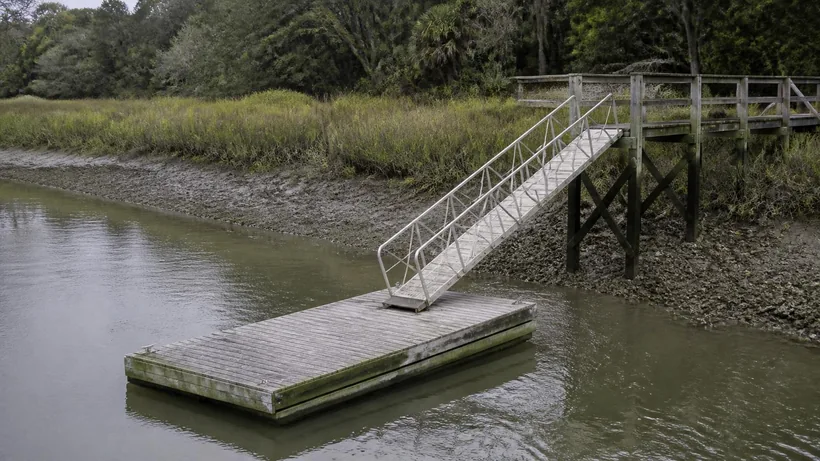
Why almost every dock here has one
A fixed pierhead is at a fixed height. The water is not. With the range Charleston gets, a fixed-only dock is comfortable for a couple of hours either side of high water and increasingly awkward as the tide drops away beneath it.
The float solves that by moving. It rides up and down with the water so the step from dock to boat stays roughly constant, and the gangway from the fixed pierhead down to it takes up the difference.
That is the whole logic of the standard Lowcountry arrangement, and it is why a design that looks over-complicated on paper is actually the simple answer to a tide problem.
Sizing and freeboard
A float is sized for the loads it will carry and the freeboard it should hold while carrying them.
Freeboard is the height of the deck above the water. Too low and the float is wet underfoot and awkward with any chop or wake. Too high and boarding a small boat becomes a climb down. The target is a compromise between those, set against the boats that will actually use it.
Loads include people, and people cluster. A float sized for an even distribution behaves differently when six people stand on one corner to watch something. Reserve buoyancy is what keeps that from being a problem.
Float construction
- Encapsulated foam billets under a framed deck, the common arrangement, where the foam provides buoyancy and the encapsulation protects it.
- Poly float drums, which are simple and repairable but behave differently in a seaway and can be noisier.
- Concrete floats, heavier and more stable, and a larger proposition to install and to move.
- In all cases the detail that matters most in a salt creek is how the buoyancy is protected from damage and from marine growth, because exposed foam does not last.
The gangway is a real engineering item
The ramp between pierhead and float is often treated as an accessory and it is not.
Its length determines its slope, and slope changes constantly as the tide moves the float. At the extremes of the cycle a short ramp becomes steep, and steepness is the difference between a dock that everyone in the household uses and one that some people avoid. Erring longer is usually worth it.
The hinge at the top and the rollers or slide at the bottom are both wear points in a corrosive environment carrying repeated live load, and they are the items on a float system most likely to need attention.
Aluminum is the usual material because it is light enough to handle and does not rot. It is also in contact with other metals and with treated timber, which makes the connection detail a corrosion question.
Creeks that go dry
Plenty of good Lowcountry dock sites sit on creeks that drain substantially at low water, and a float on one of those will sit on the bottom for part of the cycle.
That is normal here, and it is manageable when the float is built for it: the structure has to take the load of resting on an uneven bottom rather than being supported evenly by water, and the bottom surface has to tolerate contact with mud and shell.
A float specified for permanently floating service and then grounded twice a day is a float that will fail early. It is worth being explicit about this at design time rather than assuming.
Maintenance
- Check the gangway hinge and the lower rollers or slide pads, which take the most cyclical load.
- Check float attachment points and guide piles for wear and for movement.
- Look under the float for damage to the buoyancy where it can be seen, particularly on a creek where it grounds.
- Watch growth on the float and on any guide piles, which adds weight and accelerates wear.
- Treat corroding hardware as a scheduled replacement rather than a surprise.
Guide piles, and why floats wander
A float is held in position by guide piles, and those piles do more work than their simplicity suggests.
They take repeated lateral impact from the float as wind, wake and current push it, and they do it through a full tide cycle twice a day. The wear point is where the float hardware bears on the pile, and it is one of the first places a float system loosens up.
Growth on guide piles adds friction and accelerates wear on the bearing surfaces. A float that has started to bind or to sit at a slight angle is usually telling you about its guides rather than about itself.
Storm preparation
Floats are vulnerable in serious weather for an obvious reason: they are designed to rise with the water, and surge takes them higher than the guide piles were built to allow.
The failure mode is a float lifting off the top of its guides and leaving the structure entirely, which is both an expensive loss and a large object loose in a creek. Guide pile height is therefore a design decision with a storm dimension, not just a tide one.
Before serious weather, clearing loose items off the float and checking the gangway attachment are the two cheapest things an owner can do.
Floating docks and gangways for a six-foot tide — common questions
How much freeboard should a float have?
Enough that it stays dry and comfortable underfoot with people and gear on it, and low enough that boarding a small boat is a step rather than a climb. It is a compromise set against the boats that will actually use it.
What happens to a float in a storm?
The failure that matters is the float rising on surge until it lifts clear of its guide piles and leaves the structure. Guide pile height is therefore a storm decision as much as a tide one, and clearing loose items off the float beforehand is the cheapest precaution there is.
How big should my floating dock be?
Large enough for the boats using it and for people to move around them safely, with reserve buoyancy for the load clustering in one place. Bigger floats are more stable and more useful; they are also more structure to permit, build and maintain, and the permitted footprint may constrain the answer.
How long should the gangway be?
Long enough that the slope stays manageable at the extremes of the tide. A short ramp is cheaper and becomes uncomfortably steep at low water; a longer one costs more and stays usable. For most households the longer ramp is the better decision.
Is it a problem if the float sits on the mud at low tide?
Not if it was built for it. Grounding is normal on many Charleston creeks and the float has to be specified to take the load of resting on an uneven bottom. A float built for permanently floating service and then grounded daily will fail early.
Do floats need to come out in winter?
Not for ice here, unlike northern installations. They stay in. Storm preparation is the seasonal consideration on this coast rather than winter removal.
What fails first on a float system?
Hardware and the gangway connections, generally. The hinge at the top and the rollers at the bottom carry repeated live load in salt air, and they will want attention before the float or the deck does.
Can a float be added to an existing fixed dock?
Often, provided the pierhead can take the gangway connection and the permitted footprint allows the float. It is a common improvement on older fixed-only docks, and it usually transforms how much the structure gets used.
Talk through your site
Start with the survey and the critical line. Everything else follows from those two things.
Related work
Dock Construction
New private docks built for the creek you actually have.
Dock Permitting
The OCRM critical line, the joint application, and what decides your footprint.
Boat Lifts
Lift selection sized to the boat, the tide range and the pierhead.
Pierheads & Walkways
The walkway across the marsh and the pierhead at the end of it.
Dock Repair & Rebuilds
Decking, stringers, piles and hardware on an existing structure.
Where we do it
Mount Pleasant
Shem Creek to the Wando, and everything off Rifle Range Road.
Sullivan's Island
Cove Inlet and the back-island creeks.
Isle of Palms
The Intracoastal side, Hamlin Sound and the marina reach.
Daniel Island
Beresford Creek, Ralston Creek and the Wando frontage.
James Island
Ellis Creek, Clark Sound and the Stono side.
Johns Island
Bohicket, Church Creek and the deep Stono bends.