Home › Services
Dock repair, and telling repair from rebuild
Most dock problems are cheaper caught early than diagnosed late. The exception is anything below the waterline.
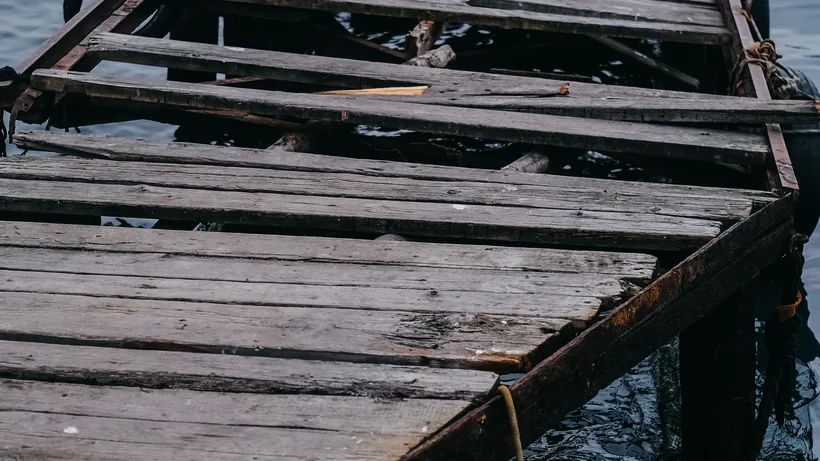
Three kinds of problem
It helps to separate what is wrong with a dock into levels, because the cost and the urgency differ enormously between them.
Surface and hardware problems are maintenance. Cupped or soft boards, fastenings standing proud, a seized gangway hinge, float attachments working loose, corroded cleats. Annoying, visible, and comparatively inexpensive.
Framing problems are the middle tier. Stringers softening where they bear on piles, joist hangers failing, a section of pierhead with noticeable movement underfoot. Repairable, usually in sections, and the right moment to inspect everything else while things are open.
Pile problems are structural. Everything above depends on them, and they are the level at which a repair conversation can turn into a rebuild conversation.
What the environment does
Marine borers are the quiet one. They work below the waterline, which is where nobody looks, and they enter through damage to the treated envelope of a pile. A pile that looks fine at deck level can have lost significant section down where it matters.
Corrosion works on the hardware faster than on the timber, and dissimilar metals in contact accelerate each other. A structure that was built with a mixed and unconsidered hardware specification ages faster than one that was not.
The wet-dry cycle and the sun work on the deck surface, which is why decking is the most visible ageing and, misleadingly, rarely the most serious.
Storm loading is episodic rather than continuous, but it finds whatever was already weak.
Inspecting your own dock
- Walk the whole structure slowly and feel for movement and soft spots rather than just looking.
- Look at every fastening you can see. Standing proud, weeping rust, missing.
- Look at where stringers meet piles. That junction is where framing trouble starts.
- Check the gangway hinge and the lower bearing, and the float attachment points.
- At low water, look at the piles below the usual waterline for damage, section loss and marine growth.
- Look at guide piles for the float, which take repeated impact.
- Do it once a year and after any significant storm.
When repair becomes rebuild
There is a threshold, and it is worth naming because owners often cross it gradually without deciding to.
If the piles are sound and the problems are above them, repair is almost always the right answer and the structure has years left in it.
If multiple piles have lost section or moved, the arithmetic changes. Replacing piles under an existing structure is more difficult and more expensive per pile than driving them on a clear site, because the work has to happen around what is already there. Past a certain number, rebuilding is both cheaper and better.
There is also a permitting dimension that surprises people: repairing a structure in kind and substantially reconstructing it are not always treated the same way. A project that started as maintenance and grew can find itself needing authorization it did not originally require. Worth raising before the work expands rather than during it.
After a storm
Look before using it. Damage from storm loading is frequently below the waterline or at connections rather than obvious on the deck surface, and a structure that looks intact can have moved.
Check pile alignment against how you remember it. Look for framing that has shifted relative to piles, and for hardware that has pulled.
Check the float and its guides, which take a beating, and the gangway, which can come off its bearing.
Photograph everything before anything is moved or repaired.
What a repair costs you in access
The thing that makes dock repair different from most building work is that the job site is over water and reached along the structure being repaired.
That constrains everything. Material has to be carried out or floated in. Waste has to come back the same way. Equipment that would be trivial to position on land may not be positionable at all, and on a long crossing or a compromised structure the safe working method changes.
This is why repairs sometimes carry a cost that looks disproportionate to the quantity of material involved. The material is rarely the expensive part. Getting people and material to the right point over a tidal marsh, in a working window set by the tide, is.
Sequencing repairs sensibly
If several things need attention, the order is worth thinking about rather than doing the most visible first.
Structure before surface, always. Replacing decking over framing that will need opening up within two years means paying for the same access twice.
Anything that requires the gangway or float to come off is worth grouping into one visit. So is anything below the waterline, because that work is tide-dependent and the windows are the scarce resource.
And if a pile assessment is due, do it before committing to the rest, because a bad answer there changes what the sensible scope is.
Dock repair, and telling repair from rebuild — common questions
How much does access add to a repair?
Often a great deal, and it is the part owners least expect. The job site is over water and reached along the structure being repaired, so material, waste and equipment all move the hard way, in windows set by the tide.
In what order should repairs be done?
Structure before surface, always. Replacing decking over framing that will need opening up within two years means paying for the same access twice. Group anything needing the float or gangway removed, and settle a pile assessment before committing to the rest.
How do I know if my dock piles are still sound?
You have to look below the usual waterline, which means looking at low tide and looking properly. Section loss from marine borers happens where it cannot be seen from the deck, and a pile can look completely normal at the top while being badly compromised lower down.
Can I just replace the decking?
If the framing and piles underneath are sound, yes, and it is one of the highest-value improvements on an older dock. It is also the ideal moment to inspect the structure beneath while it is exposed, which is worth more than the decking itself.
Do I need a permit to repair my dock?
Repairing in kind and substantially reconstructing are treated differently, and the line is lower than most owners assume. If the scope is growing beyond replacing what is there with the same thing, that is the point to check rather than after.
My dock bounces when I walk on it. Is that dangerous?
It is a reason to have it looked at rather than to ignore. Movement usually means framing has lost connection or stiffness somewhere, and the structure is telling you where to look. It rarely improves on its own.
How long does a dock last here?
A maintained structure lasts a long time; an unmaintained one in a salt creek ages quickly. The variable is far less the original build quality than whether somebody has been replacing hardware and looking at the piles along the way.
Is it worth repairing a dock I inherited with the house?
Usually yes, if the piles are good. The piles are the expensive part and the part that is hardest to replace under an existing structure. Get those assessed first, because that single answer largely determines whether you are looking at a repair or a rebuild.
Talk through your site
Start with the survey and the critical line. Everything else follows from those two things.
Related work
Dock Construction
New private docks built for the creek you actually have.
Dock Permitting
The OCRM critical line, the joint application, and what decides your footprint.
Boat Lifts
Lift selection sized to the boat, the tide range and the pierhead.
Floating Docks
Floaters and ramps that stay usable through a six-foot tide swing.
Pierheads & Walkways
The walkway across the marsh and the pierhead at the end of it.
Where we do it
Mount Pleasant
Shem Creek to the Wando, and everything off Rifle Range Road.
Sullivan's Island
Cove Inlet and the back-island creeks.
Isle of Palms
The Intracoastal side, Hamlin Sound and the marina reach.
Daniel Island
Beresford Creek, Ralston Creek and the Wando frontage.
James Island
Ellis Creek, Clark Sound and the Stono side.
Johns Island
Bohicket, Church Creek and the deep Stono bends.