Home › Services
Dock construction on the Charleston creeks
A new dock is a structure built over public tidelands under permit conditions. What gets built is decided by the water in front of you and the permit behind you.
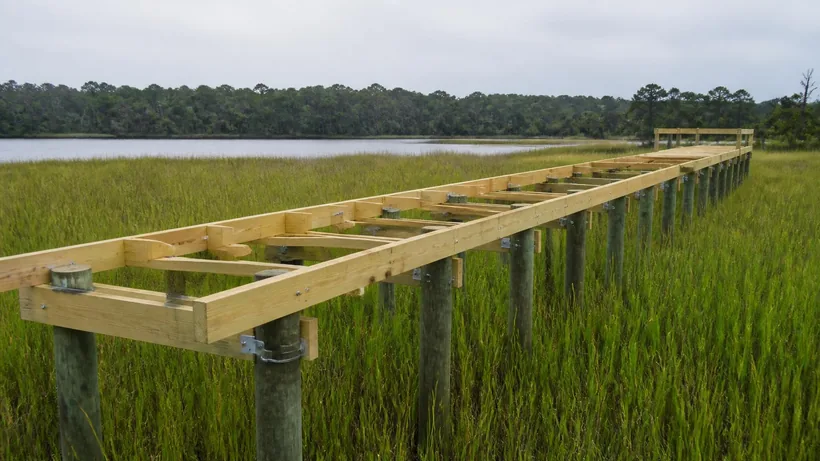
What a Lowcountry dock is made of
Strip away the variations and a private dock here has four parts, and each one answers a different problem.
The walkway crosses the marsh. Its job is to get you from high ground to water without sitting on the spartina, and its length is set by geography rather than preference. It is framed high enough to clear spring tides and storm wash, and on longer crossings it is the single biggest line in the project.
The pierhead is the fixed platform at the end. This is where people actually spend time, and it is also the part the permit constrains most tightly, because its footprint is measured area over tidelands. Its size is a permit outcome, not a design choice.
The gangway and float handle the tide. An aluminum ramp runs from the fixed pierhead down to a floating dock so there is a working surface at boat level regardless of where the water sits in the cycle.
The lift, where one is permitted and wanted, holds the boat out of the water between uses. Keeping a hull out of a salt creek is the cheapest maintenance decision an owner makes.
Piles are the whole structure
Everything above the waterline is carried by what is below it. Timber piles are driven rather than augered wherever conditions allow, because driving develops far better capacity in Lowcountry ground than placing a pile in a bored hole does.
Depth is a site answer. The mud here can run deep before anything competent appears, and the number of feet a pile has to travel to reach holding ground varies considerably across short distances. This is one of the reasons a figure quoted without a site visit is not a real figure.
Spacing follows from span. Closer piles mean more piles but lighter framing; wider spacing means fewer piles carrying more load and deeper members between them. Neither is universally right.
Access decides the method
There are two ways to build a dock here and the site chooses between them.
Land-based work runs equipment from the high ground out along the structure as it advances. It is the faster and simpler option and it is available when the crossing is short enough and the bank will take the load.
Barge work happens from the water. Once the crossing gets long, or the marsh will not carry equipment, or the pierhead sits well out in the creek, the job becomes a floating operation. That brings tide windows into the schedule: there are hours of the day when a barge can work a given site and hours when it cannot, and that shapes how long the build takes independently of how much work there is.
Owners sometimes read a longer schedule as a slower crew. More often it is a tide calendar.
Covered pierheads and the things people assume
- A roof over the pierhead is not automatic. Covered structures are treated differently from open ones and the permit decides whether one is possible on your site.
- Power and water out to the pierhead is a separate piece of work with its own requirements, and it wants planning before the decking goes down rather than after.
- Boat lifts are not a later add-on in every case. Where a lift is intended, it belongs in the permitted design, because it affects both the structure that carries it and what was approved.
- Railings, benches, ladders and cleats are genuinely discretionary and are the right place to spend or save once the structural questions are settled.
Materials that survive the environment
Salt, sun and a twice-daily wet-dry cycle are hard on everything. Treated timber remains the structural standard for framing and piles. On the deck surface the real choice is between treated timber, composite and hardwood, and the honest trade is up-front cost against ongoing attention: composite avoids splinters and refinishing but runs hot in summer, timber is cheaper and cooler but wants maintenance, hardwood sits between.
Fastenings matter more than the species does. In a salt environment hardware degrades ahead of timber, and dissimilar metals in contact accelerate each other. Getting the hardware specification right at build time is quiet, invisible work that pays for itself years later.
What drives the cost
- Length of the marsh crossing, which sets framing, decking and pile count.
- Pile depth and driving conditions on your particular bottom.
- Land access versus barge access, which changes both method and schedule.
- Permitted pierhead area and whether a cover is allowed.
- Whether a gangway, float and lift are part of the scope.
- Deck material and hardware specification.
- Utilities, if power or water is going out to the pierhead.
Those variables move real money, which is why two projects on the same street can land in genuinely different places. A contractor puts a number on it after seeing the survey and standing on the site. Anything offered before that is a guess wearing a number.
Dock construction on the Charleston creeks — common questions
Who owns the dock once it is built?
The structure is yours, but it sits under an authorization with conditions attached, and those conditions run with it. Building something materially different from what was approved creates a compliance problem even when the result is smaller.
Can I add to the dock later?
Additions to a permitted structure go back through review rather than being made unilaterally, and the threshold for what counts as a change is lower than most owners assume. If a lift or a cover is likely later, it is cheaper to include it in the original design.
Can I build the dock first and permit it afterwards?
No. Work in tidelands without authorization creates an enforcement problem rather than a dock, and unwinding it is considerably more expensive and slower than permitting the project properly at the start. Permitting comes first, always.
How far out does the walkway have to go?
As far as it takes to reach water that is usable at the stage of tide you care about, subject to what the permit allows. On some lots that is a short run. On others it is a substantial crossing, and that distance is the single largest variable in the project.
Do I need a lift, or is a float enough?
It depends on the boat and the creek. A lift keeps the hull out of salt water between uses, which reduces growth and corrosion and is generally worth it for a boat kept on site permanently. A float alone is fine for kayaks, small craft, and boats that live on a trailer most of the time.
What happens if my neighbor already has a dock close to the property line?
Proximity to existing structures is one of the things reviewed, and it can constrain where your walkway and pierhead may sit or, on a narrow frontage, whether a dock is possible at all. It is one of the first things worth checking rather than one of the last.
Is a dock possible on a creek that goes dry at low tide?
Often yes, but it is a different product. A float on a creek that drains will rest on the bottom for part of each cycle, which is survivable when the float is specified for it and damaging when it is not. The usable window for a boat is also shorter, and that is worth being clear-eyed about before building.
How much of the schedule is construction?
Usually the smaller part. Permitting is measured in months; the build itself is measured in weeks for most private docks, stretched by tide windows where barge work is involved and by pile driving conditions.
Talk through your site
Start with the survey and the critical line. Everything else follows from those two things.
Related work
Dock Permitting
The OCRM critical line, the joint application, and what decides your footprint.
Boat Lifts
Lift selection sized to the boat, the tide range and the pierhead.
Floating Docks
Floaters and ramps that stay usable through a six-foot tide swing.
Pierheads & Walkways
The walkway across the marsh and the pierhead at the end of it.
Dock Repair & Rebuilds
Decking, stringers, piles and hardware on an existing structure.
Where we do it
Mount Pleasant
Shem Creek to the Wando, and everything off Rifle Range Road.
Sullivan's Island
Cove Inlet and the back-island creeks.
Isle of Palms
The Intracoastal side, Hamlin Sound and the marina reach.
Daniel Island
Beresford Creek, Ralston Creek and the Wando frontage.
James Island
Ellis Creek, Clark Sound and the Stono side.
Johns Island
Bohicket, Church Creek and the deep Stono bends.