Home › Services
Boat lifts sized to the boat, the tide and the pierhead
A lift is the cheapest hull maintenance decision an owner makes, and the most structurally demanding thing hung off a dock.
Why owners fit them
A boat kept in a salt creek is being worked on continuously by the water it sits in. Growth on the hull, corrosion on running gear, and the slow attrition that comes from permanent immersion all proceed whether the boat is used or not.
Lifting the hull clear between uses stops most of that. It also removes the daily anxiety about wind, wake and tide moving a boat against a structure, and it makes the boat easier to keep clean.
The counterweight is that a lift is a piece of machinery in a corrosive environment carrying a heavy load over water, mounted on a structure that has to be built to take it.
Capacity is not the boat weight
The most common specification error is sizing to the manufacturer dry weight on the brochure.
The load that matters is the boat as it actually sits: fuel and water aboard, batteries, engine or engines, hardware, gear, and whatever has accumulated in the lockers over a few seasons. That number can be meaningfully higher than the dry figure, and a lift sized to the optimistic version is one being run at the edge of its rating every time it is used.
Beam and hull form matter too, because the bunks or slings have to support the hull where the hull wants to be supported. A lift that carries the weight but cradles the boat badly is still the wrong lift.
The tide range sets the lift type
This is where a Charleston creek differs from a lake or a low-range coast.
A lift has to lift from where the water actually is, and here that position moves substantially twice a day. Travel has to cover the working range, which pushes toward configurations with enough vertical reach and rules out some designs that are perfectly reasonable elsewhere.
On a creek that drains at low water, the low end of the cycle is a further constraint: the boat has to be retrievable and launchable within a usable window, and the lift has to tolerate the conditions at the bottom of the tide.
Common configurations
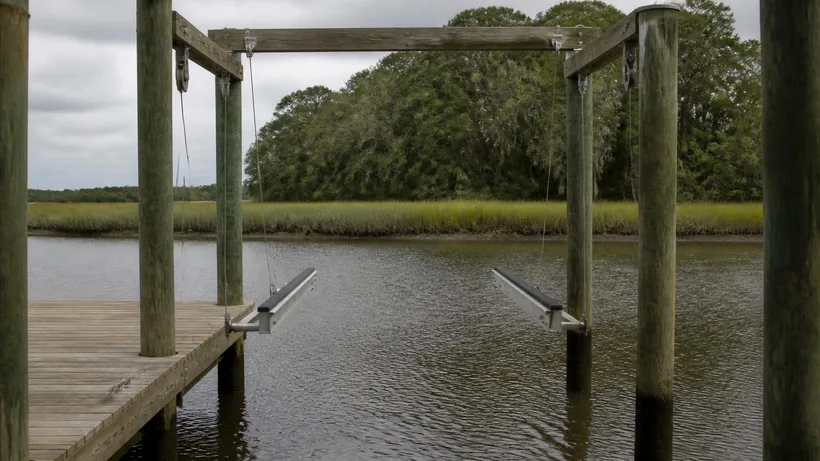
- Four-pile cradle lifts, the conventional arrangement where the pierhead and pile layout allow it, with the boat carried on bunks between beams.
- Elevator or vertical platform styles, which suit some sites and some hulls better and interact differently with the structure.
- Davit arrangements for small craft, tenders and personal watercraft, which are a much lighter structural proposition.
- Floating lift systems that sit in the water rather than hanging from the structure, which change the structural question but bring their own maintenance picture.
The structure has to be designed for it
This is the point most worth making. A lift concentrates a large load, applied and removed repeatedly, at specific points on the dock. That is a structural design input, not an accessory fitted later.
Where a lift is intended, the pile layout, pile depth and framing around the pierhead should account for it from the start. Retrofitting a lift onto a dock that was not designed to carry one sometimes works and sometimes means adding piles and reframing, which is a larger job on an existing structure than it would have been on a new one.
Where a lift is intended, it also belongs in the permitted design rather than appearing afterwards.
Corrosion and maintenance
Everything on a lift that moves is in salt air, and much of it is over salt water.
Cables are consumables. They are inspected rather than trusted, and they are replaced on condition. Failure of a lifting cable under load is the failure mode with real consequences, and it is also the one most reliably caught by looking.
Motors, gearboxes and switchgear want their enclosures intact and their connections dry. Sacrificial anodes, where fitted, are doing their job by being consumed and want checking.
Bunks and carpet degrade and can quietly start marking a hull. Guides and bumpers take repeated impact.
None of this is onerous, but it is not a fit-and-forget installation either.
Operating one without shortening its life
Most lift damage is not dramatic. It accumulates.
Level the boat before lifting rather than after. A hull hoisted crooked loads one side of the cradle and one set of cables disproportionately, and doing that habitually is how a lift ages unevenly.
Do not leave the boat hanging at full travel when it does not need to be there. Do not run the lift with a fouled or obstructed cable path. Rinse the machinery when you rinse the boat, because the salt that lands on the hull lands on the lift too.
And stay with it while it moves. A lift is the one piece of equipment on a dock that can do real damage while unattended, and the failures that matter tend to announce themselves with a noise before they announce themselves with a consequence.
Storm season
Decide in advance what happens to the boat when weather is coming, because the decision is worse made in a hurry.
A lift is not a storm mooring. Boats left on lifts in serious weather are exposed to wind loading at height and to surge that can lift a hull off its bunks entirely, and the structure carrying them was designed for a static load in ordinary conditions.
For most owners the plan is to remove the boat well ahead of a storm rather than to trust the lift, and the useful version of that plan includes where the boat goes and how much notice the move needs.
Boat lifts sized to the boat, the tide and the pierhead — common questions
What maintenance does a lift actually need?
Inspect cables for broken strands, corrosion and flat spots; keep motor and switchgear enclosures intact and connections dry; check anodes where fitted; watch bunks and carpet for wear that could mark a hull; and rinse the machinery when you rinse the boat.
Can a lift be installed at the same time as the dock?
That is the better way to do it. A lift concentrates a large repeated load at specific points, so the pile layout, pile depth and framing should account for it from the start rather than being adapted afterwards.
What lift capacity do I need?
Size to the boat as it floats loaded, not to the dry weight in the brochure. Fuel, water, batteries, engines, hardware and accumulated gear add up, and a lift run permanently near its rating has a shorter and less forgiving life than one with headroom.
Can a lift be added to my existing dock?
Sometimes directly, sometimes only after adding piles and reframing the pierhead to carry the concentrated load, and sometimes not without a rebuild of that section. It depends entirely on how the existing structure was built. A lift also generally belongs in the permitted design rather than being an unrecorded addition.
How does the tide range affect which lift I can use?
It sets the vertical travel the lift has to cover. The water is in a very different place at high and low tide here, and a configuration that works on a low-range coast can leave you unable to launch or retrieve for part of the cycle.
How often should lift cables be replaced?
On condition rather than on a fixed calendar, which means they have to be inspected to be managed. Look for broken strands, corrosion, flat spots and deformation, and treat any of those as a reason to replace rather than to watch.
Will a lift stop growth on the hull entirely?
It removes the main cause by taking the hull out of the water between uses, which is why owners fit them. It does not eliminate maintenance, and the lift itself becomes something that needs looking after in exchange.
Is a lift worth it for a boat used a few times a year?
Often yes, and arguably more so. A boat used rarely spends more time sitting in salt water doing nothing, which is exactly the condition a lift is designed to avoid.
Talk through your site
Start with the survey and the critical line. Everything else follows from those two things.
Related work
Dock Construction
New private docks built for the creek you actually have.
Dock Permitting
The OCRM critical line, the joint application, and what decides your footprint.
Floating Docks
Floaters and ramps that stay usable through a six-foot tide swing.
Pierheads & Walkways
The walkway across the marsh and the pierhead at the end of it.
Dock Repair & Rebuilds
Decking, stringers, piles and hardware on an existing structure.
Where we do it
Mount Pleasant
Shem Creek to the Wando, and everything off Rifle Range Road.
Sullivan's Island
Cove Inlet and the back-island creeks.
Isle of Palms
The Intracoastal side, Hamlin Sound and the marina reach.
Daniel Island
Beresford Creek, Ralston Creek and the Wando frontage.
James Island
Ellis Creek, Clark Sound and the Stono side.
Johns Island
Bohicket, Church Creek and the deep Stono bends.